
By Harsh Upadhyaya, EDSAFE AI Alliance
As AI proliferates, there is a serious concern about the pervasive shadow environment it creates. An unmonitored AI environment without critical guardrails poses many governance and security risks, such as teachers uploading student work to free chatbots without a data privacy agreement in place. According to a recent RAND study, 54% of students and 53% of core subject teachers were using AI for school in 2025. Yet, only 35% of district leaders say they provide students with AI training, and over 80% of students report that their teachers have not explicitly taught them how to use AI for schoolwork.
Some districts have responded to the growing shadow environment through professional development. Although investment in professional development training has grown, 42% of teachers still report having no AI training at all. One-time professional development workshops delivered in a standardized approach do not support teachers at their varying levels of ability and desire.
Education has long grappled with disruptions born of new technology, whether it was the shift to writing in ancient Greece or the modern arrival of calculators and the public internet. Each new technology brought fears about what students would lose, forcing schools to rethink how they teach and assess. Those shifts often depend less on the tools themselves than on the people shaping those practices, so managing the SAFE and effective integration of AI requires a change management lens.
Prosci founder Jeff Hiatt created the ADKAR model after studying change patterns in over 700 organizations. ADKAR is an acronym for the five outcomes people need to achieve for lasting change: Awareness, Desire, Knowledge, Ability, and Reinforcement.
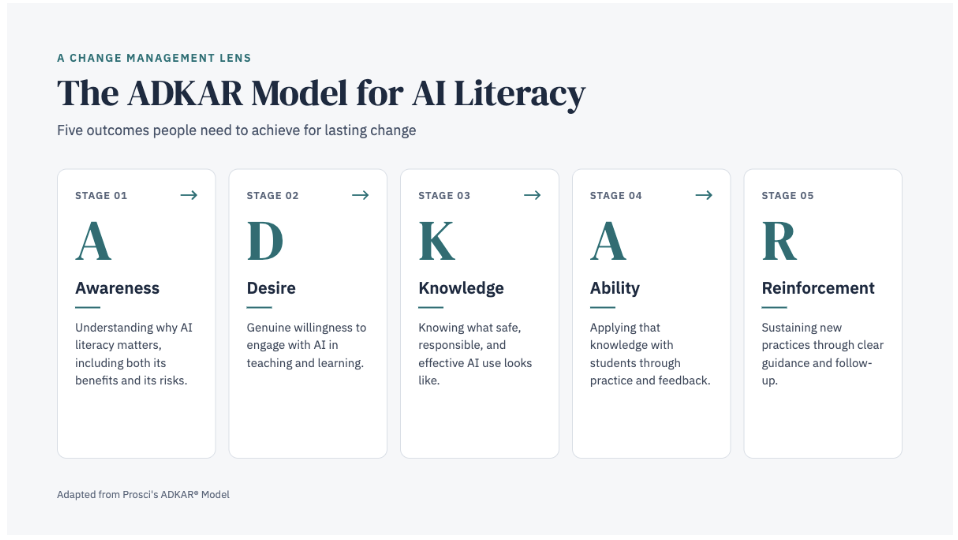
Caption: The ADKAR Model for AI Literacy (adapted from Prosci’s ADKAR® Model)
Since people stall at different stages, support must match them where they are stuck. A teacher who doesn’t see why AI literacy matters gains little from an AI-prompting workshop. A parent who sees AI strictly as a threat gains little from a guide on household usage rules. Desire, Ability, and Reinforcement are often the hardest stages to address because they require sustained time, trust, and follow-up.
Awareness: Developing a shared understanding and language of both the benefits and the risks. RAND found that 61% of parents and 55% of high school students believed greater AI use would harm student critical thinking, compared to only 22% of district leaders. Closing that gap requires a two-way approach: leaders should communicate their plans transparently, while also listening openly to community concerns.
Try this: Host AI sandbox nights where parents, students, and educators test tools and collaboratively outline district expectations.Desire: Focus on building genuine willingness among key stakeholders to participate in the change and move forward. When asked how eager they are to learn about integrating AI into their teaching, 37% of teachers said not at all or only slightly. A teacher stuck at this stage may understand why AI literacy matters, but considers it as one more initiative.
Try this: Start a staff meeting by having teachers write their biggest AI concern on a card, then group the cards and dedicate the next three PD Sessions to the top three concerns.Knowledge: Provide training and support for stakeholders to build their understanding and confidence around this change. Be sure to include clear guidance on the safe, responsible, and effective use of AI. This needs to support performance in the current transitional period as well as in the ideal future state.
Try this: Create grade-level quick-reference guides with concrete side-by-side examples of acceptable use, questionable use, and academic dishonesty.Ability: Change happens in behaviors, mindsets, and other outcomes through practical knowledge application. In teaching and learning, key outcomes include modeling responsible AI use in the classroom and redefining assessments to value process over product. Ability takes practice, yet only 9% of teachers report receiving ongoing training. A teacher stuck in this stage likely had the training and knows the guidance, but struggles to apply it with students.
Try this: Run peer co-planning sessions where teachers try one small AI-integrated activity, test it in class, and spend 10 minutes debriefing at their next meeting.Reinforcement: Effective change takes time to stick, and people have natural tendencies to slip back into comfortable patterns. A teacher stuck in this stage started strong after training but gradually stopped, with no follow-up or clear expectations. Clear policy is an anchor, yet just 45% of principals report school or district policies on AI, and only 34% of teachers report policies on AI and academic integrity. Leaders also need to explicitly name and recognize the practices they want to see and establish visible follow-up expectations.
Try this: Schedule check-ins four to six weeks after training, where leaders observe and recognize the practices teachers are using.
The ADKAR model has limits. Though it models individual change, that change depends on system support. A recent national study of school principals found that 58% of schools have no written AI policy, and that schools serving more disadvantaged students lag behind on AI integration. Closing the gap will take districts pairing AI adoption with professional development and guided practice. AI literacy is a change process, and it requires us to ask where people are stuck. National AI Literacy Day® is the time to ask!
