
Prompt & Circumstance: Navigating AI Literacy in Higher Education
Part 2: Promising Practices in Action
In Part 1 of our blog series on higher education, we shared data that establishes the urgent need for structured AI literacy training across the field. As generative tools evolve and AI becomes more central in our everyday lives, one-off workshops and fragmented policies are no longer enough to meet the demand. Now, the central challenge for college and university leaders is figuring out how to build literacy at scale.
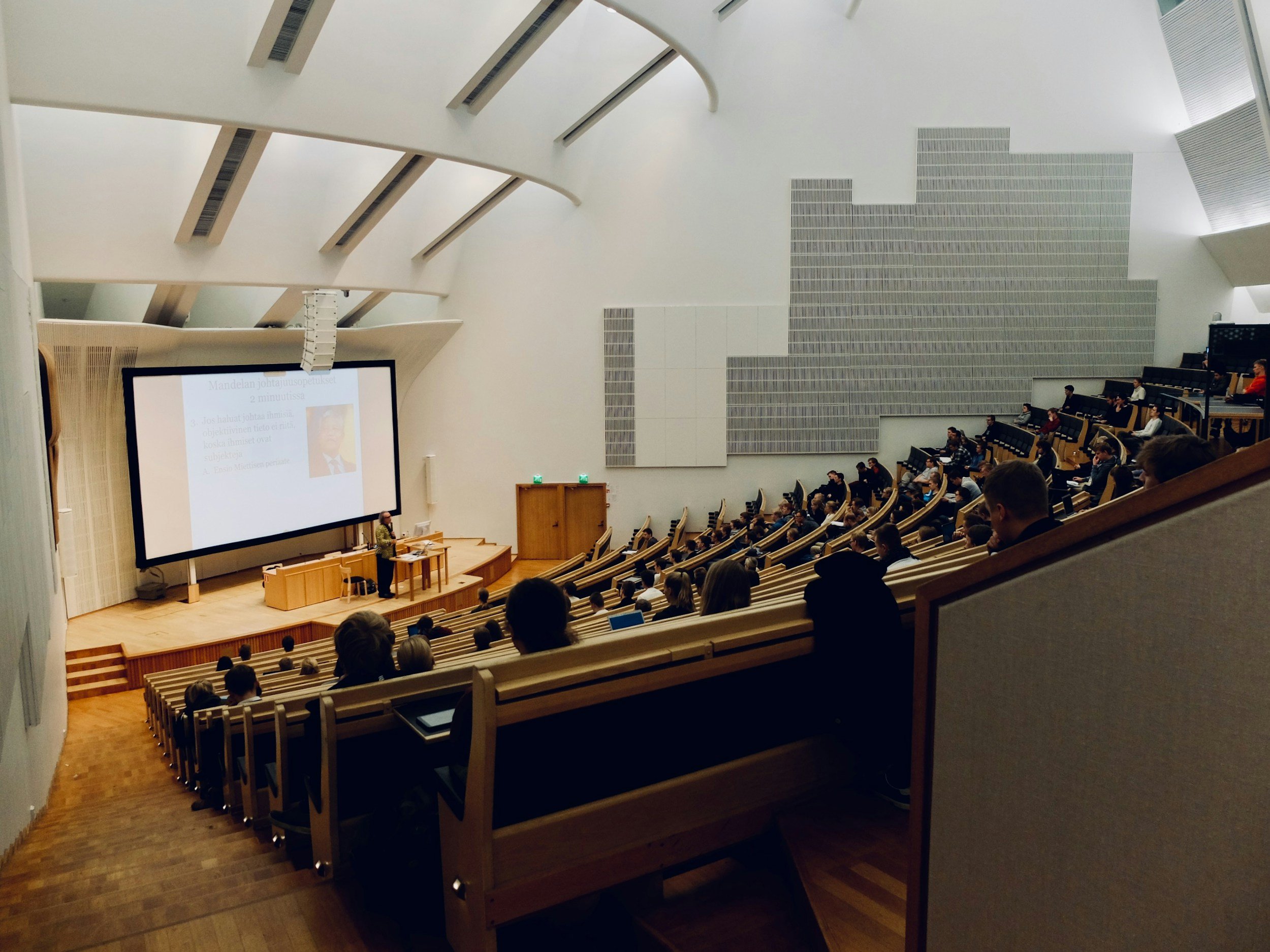
Caption: College students sitting in a lecture hall, listening to a lecture on AI systems.
Promising Practices
Across the country, institutions are testing new models by establishing dedicated task forces, integrating generative tools into coursework with intentionality, and creating campus-wide frameworks and ethical guidelines. Here are just a few of the promising models that foster AI literacy among students and faculty:
The Ohio State University (Columbus, OH) is integrating AI skill-building beginning in students’ first year, integrating foundational generative AI skills into their required General Education Launch Seminar and First Year Success Series. In addition, all students will have access to a new “Unlocking Generative AI” course, which will explore how to interact with AI creatively and responsibility, while exploring AI’s societal impact.
The Education Development Center, funded through a National Science Foundation (NSF) grant, has partnered with five community colleges in Washington, Utah, Massachusetts, Maryland, and Tennessee to embed foundational AI skills into tech programs. Their work aligns graduate competencies with local industry demand, ensuring that students exit their programs with the technical knowledge and skills to fully participate in the workforce.
Staff and faculty at the University of Louisiana system (Baton Rouge, LA) built a “Empowering AI Literacy for Students” microcredential, available at no cost to all university employees and students. This self-paced microcredential emphasizes ethics, digital literacy, and data privacy, teaching how to effectively use AI in combination with other learned skills. After they complete a final microcredential project, participants receive a badge that can be shared on social media and in job application materials.
Recognizing the importance of faculty in preparing students for an AI-enabled world, the University of Massachusetts Lowell (UML; Lowell, MA) launched the AI Faculty Mini-Grant. Faculty members across all 5 UML colleges can receive funding to incorporate at least one element of generative AI into their courses, ranging from single lessons to integrated course elements. A portion of the grant awards is dedicated to faculty-student collaboration, ensuring students actively drive AI integration across campus.
Pennsylvania State University’s AI Literacy Framework, launched in spring 2026, creates a shared vision for how the university approaches AI education and use. This framework provides 4 core AI literacy competencies: technical knowledge, ethical awareness and social responsibility, critical thinking, and practical use. The framework is also supported by a number of learning modules, instructional materials and professional development resources to support faculty literacy and integration.
Connecting Higher Education and K-12 AI Literacy
Colleges and universities are also well positioned to provide key learning experiences around AI for K-12 students in their communities. Programs like the AI and Machine Learning Summer Intensive program at the University of South Florida and Purdue University’s AI in P-12 Education Conference provide high school students and education professionals, respectively, with exposure to AI in structured, hands-on ways, and opportunities to share insights and collaborate around AI use in teaching and learning.
Extensive research and training also enables higher education to guide AI policymaking and classroom use. Tools like Stanford University’s AI Hub for Education provide educators with timely, relevant research around AI in education, giving data-backed insights into topics like integration across the curriculum. Stanford also hosts a database of Classroom-Ready Resources About AI for Teaching (CRAFT), targeted towards high school students and covering a wide range of subject matter and foundational AI literacy skills.
How Higher Education Institutions Can Get Involved
National AI Literacy Day is the perfect opportunity to jumpstart or highlight AI literacy initiatives on college and university campuses. Our asynchronous PD library contains guidebooks, recorded webinars, and online self-paced trainings perfect for faculty, while our past events page can provide inspiration on how institutions are preparing their students for an AI-enabled world. In addition, becoming a supporting organization for National AI Literacy Day 2027 can give college and university staff and leaders the opportunity to connect with other institutions both in the U.S. and abroad who are integrating AI literacy into their curriculum and campus experience.
—
AI is changing education at all stages, from early childhood to adulthood. With that comes a responsibility of colleges and universities to foster AI literacy in their students. Join the AI literacy movement today and ensure that college students have the AI literacy skills necessary to thrive in both the workforce and beyond.
