
By Amiya Harish, Students for Innovation
I co-founded Students for Innovation in eighth grade because I believed students deserved a bigger role in education conversations. What started as an interest in making classrooms more innovative has grown into a journey that has completely changed how I think about technology in education and students’ role in shaping it.
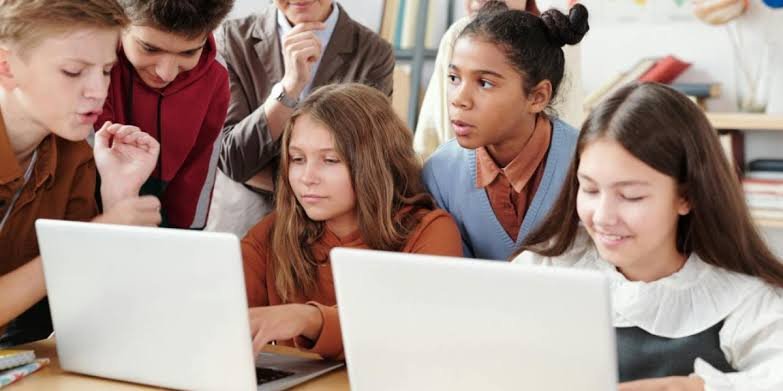
Caption: Students collaborating with each other to work write an AI responsible use policy for their school.
Through Students for Innovation, I’ve learned from educators and students who are trying to make sense of what AI means in this space. I’ve attended conferences and webinars, participated in resource development and conversations with teachers, and in every situation, I hear the variety of questions people have about AI in the classroom. The more I listen, the more I realize that there is no simple answer for how AI should fit into education. More importantly, figuring it out has to be a shared process between students and educators.
I keep thinking about how I can help my own district think through its AI policy. As conversations about how schools should approach technology continue to rapidly evolve, I realize how important it is to include students in these discussions. We are not simply preparing to enter a world shaped by AI; we are already living in it.
My experience working with educators has also taught me that AI literacy is more than just knowing how to use an AI tool. I have seen how excited educators are about the possibilities of AI, but I have also seen the uncertainty that comes with introducing a technology that raises so many new questions. How should students be allowed to use AI? How do we draw the line between using AI as a tool vs. cheating? How can AI support learning without replacing the thinking that makes it meaningful?
As a student, I have also seen how AI can support learning. Using AI intentionally has helped me understand these tools as a way to work through something I don’t understand, rather than just a way to get an answer. If I am stuck on a concept, I can use these tools to explain it differently or break it into smaller steps until I can make sense of it, without eliminating the productive struggle that is part of learning. I can use it to generate practice questions, test whether I really understand something, or get feedback on an idea before I develop it further. When used in a productive, collaborative way, AI does not remove the thinking from learning—it actually pushes my thinking further.
At the same time, how students use AI on their own can look very different from how schools discuss it. Conversations about AI in education often focus on how students might use AI to avoid doing something instead of how to use AI tools to study, brainstorm, clarify confusing material, or challenge themselves. That disconnect made me realize how important it is for educators to understand not only what AI can do, but how students are actually using it. Without those conversations, schools risk creating policies based on assumptions rather than students’ real experiences.
I don’t think students should simply be handed a set of rules that adults created for us. We should be part of the conversation.
AI is changing too quickly for anyone to have everything figured out. Teachers need to be open to learning alongside their students, and students need to have the confidence to learn alongside their teachers. Some of the most meaningful conversations about AI in education happen when neither side pretends to have all the answers.
Throughout this journey, I have learned that students have perspectives on education that adults cannot fully replicate because we experience the classroom from a completely different position. We know what engages us, where technology helps us, where it gets in the way, and what questions our peers actually ask. But having a unique student perspective is only the starting point. What matters is being willing to listen, question, and contribute to conversations with the people who teach us.
AI literacy means being able to question an AI-generated answer, recognize its limitations, understand its potential biases, and make thoughtful decisions about when using AI actually improves your learning. It also means being willing to ask bigger questions: What should AI look like in our classrooms? What do we want it to change? What should it never replace? Who gets to make those decisions? Those questions don’t belong to educators or students alone. They belong to a dialogue between both.
My work with Students for Innovation has made me even more passionate about education and advocacy, and it has shown me that students do not have to wait until we are adults to contribute meaningful ideas. We can learn from educators while also bringing personal experience as students.
AI is not the only reason education needs to change. AI is a catalyst, forcing us to confront that reality now and giving us a chance to rethink what school is preparing students for and what skills will truly matter beyond the classroom. If information is increasingly easy to access, then memorization cannot be the only goal. We should consider how schools can help students think critically and communicate ideas to better understand why something is true rather than simply knowing the answer.
For me, that change does not mean that every classroom needs to become an AI classroom or that technology should replace all traditional parts of education. It means being more intentional about why we teach what we teach and how students demonstrate what they know. The goal should not be to keep students away from AI, but to teach them how to use it without replacing their own thinking. Instead of designing education around avoiding every new technology, we can design it around helping students embrace technology thoughtfully.
Students should not just be the recipients of changes in education. We should be part of shaping them—and we should be learning how to shape them together.
